AI bubble or AI productivity boom? What my $200 a month says about it
An investment newsletter put an AI capital bubble next to AI-driven white-collar layoffs. Going from a $40 to a $200 Claude Max plan, the subprime 'rate of growth' parallel, and why my own hedge is a salaried job in Sydney.
(wouldn't the one cancel out the other?)
Something I've been reading about, hearing about a lot on X and in investment newsletters such as Luke Gromen's, is these two thoughts, and I can't quite make them compatible with each other.
I'm trying to make sense of an investment newsletter that in the latest weekly report was talking about these two things being there at the same time: that massive debt and bubble on the one side, but then also on the other side the productivity gain, therefore layoffs in the white-collar workforce.
This is an edited interview: the questions are there to push me, the answers are what I said, with the filler cut.
The short version
- The question: if the AI bubble gets repriced, AI gets more expensive, and the productivity gain behind the layoffs shrinks with it.
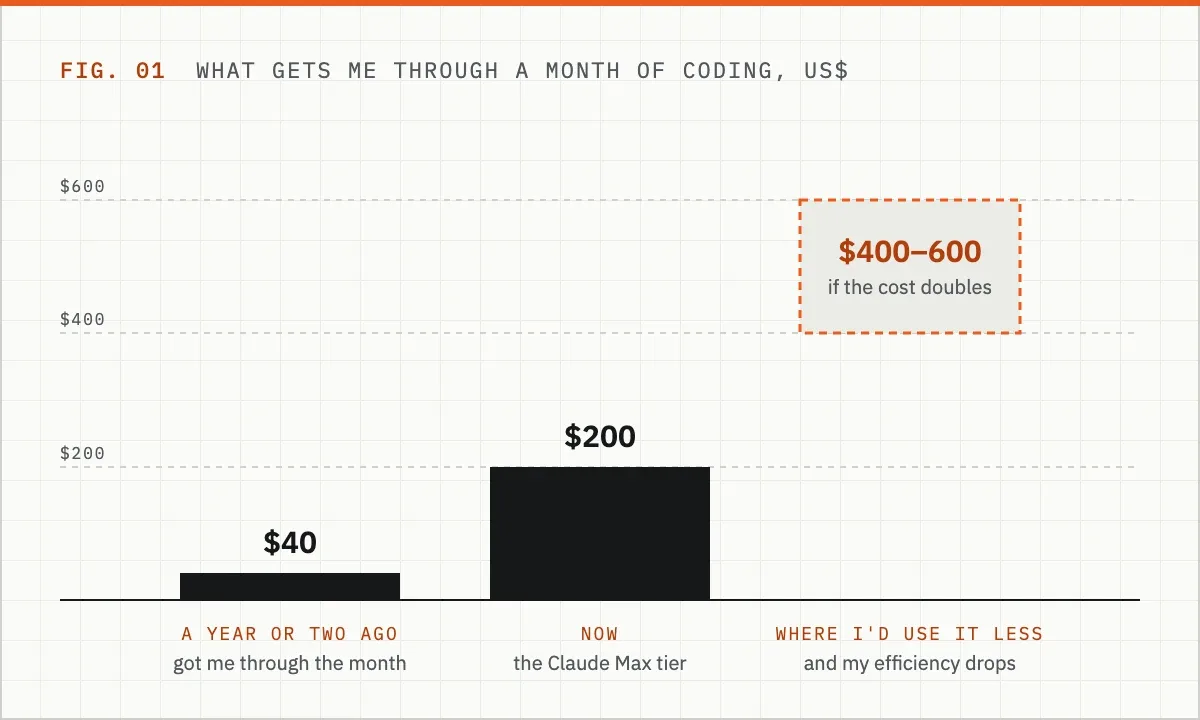
- My own price curve: the $40 tier used to get me through a month of coding. Now the $200 Claude Max tier does.
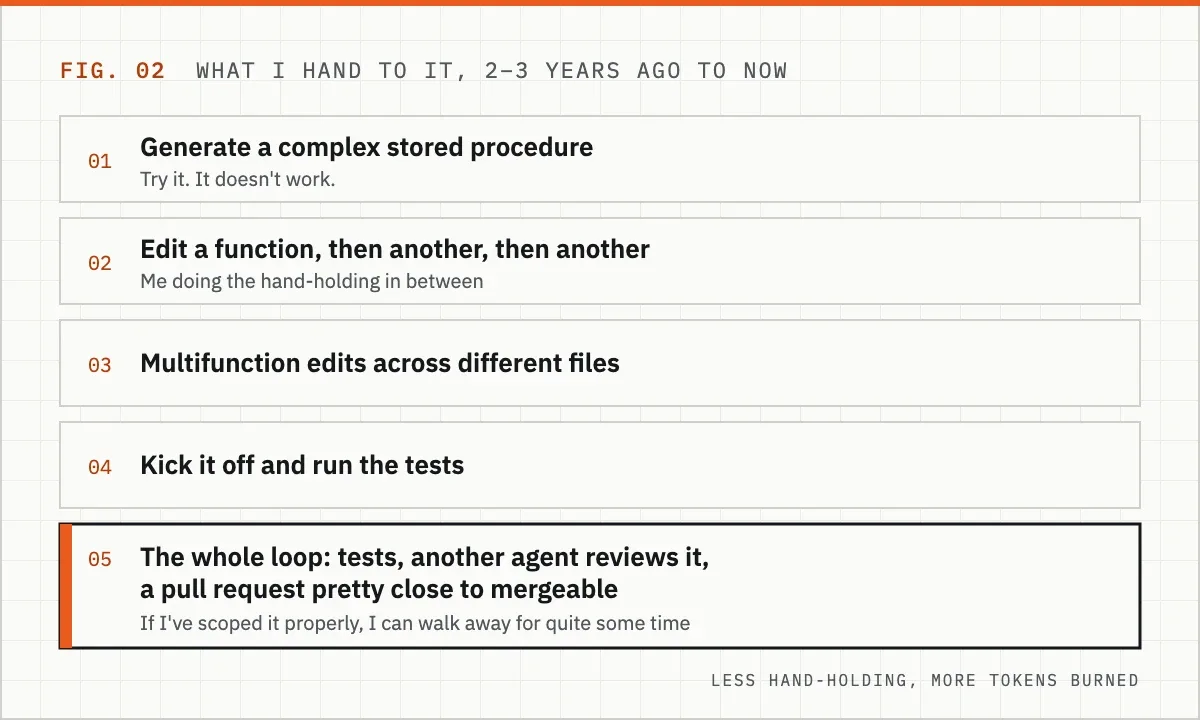
- What I get for it: from code that mostly didn't work two to three years ago to a loop that runs the tests, has another agent review it and ends in a pull request that is pretty close to mergeable.
- My answer: a bit of both. If it's a bubble, AI usage prices go up and companies maybe slow down their layoffs rather than stop them.
- My hedge: getting cash flow again through employment, moving from New Zealand back to Sydney, and ideally having someone else pay the bill for the cost of AI.
Can an AI bubble and an AI productivity boom both be true?
The first thought is we are seeing a productivity boom through AI that is leading to white-collar job losses. Companies are using AI, their employees are more productive, and therefore companies can let go of these employees. That leads to job losses and increased unemployment. And there seems to be evidence for that.
On the other side, AI is currently a lot of investment capital. We see that in the planned IPOs of ChatGPT and Anthropic, that publishing their numbers show that they are not profitable at all. They're making revenue, but not profitable. And that shows that this is currently being subsidized heavily by the companies and by the investors in these companies.
So the question to me is: currently it seems like companies are getting good productivity gains, but they're not paying the real price for that. There's that bubble forming with companies such as Anthropic that seem to be subsidizing so heavily and can't really get profitable. And if this rate of growth slows down, they will have problem funding at higher valuations and raising more capital without devaluing themselves to a lower price. So there's some sort of bubble brewing on the one side, where we have a lot of capital circular lending between these different companies, and on the other side we've got this AI productivity boom.
But wouldn't the one cancel out the other? If that AI bubble would need to be repriced based on the actual profitability of these companies, pulling out all that investor money, wouldn't that mean that the productivity boom isn't what everybody thinks it is? As soon as the prices go up, the cost of that productivity goes up too, and then it's probably not as stark. In some cases it might make more sense to keep a human to do the task instead of footing the bill for the massive AI build out.
How much more does AI for coding cost than it did two years ago?
And at what price would you stop using it?
I've been seeing it for years, that it's been slowly creeping into more expensive territory. But at the same time, the models are getting vastly better. I'm thinking back maybe 2 to 3 years ago, you could use it to review and generate lines of code, but most of the time stuff would be wrong. Let's say a complex stored procedure: you would generate it, you would try it, it wouldn't work. Whereas today, it just always works. It might not be 100% correct, but that might be a problem in how you scoped it initially.
So they're getting better, but at the same time, companies have seemed to increase the cost one pays for the tokens, or the limits they give on tokens. Currently I'm on the Claude Max tier, $200 a month, and that gets you a certain number of tokens. Whereas a couple of years ago, or a year ago, the $40 tier would get you just fine. Get you through a whole month of coding. Now the $200 tier will get you through a month of coding. You can't go above and beyond on the highest model. And there used to be deals here and there where you could get access to a cheaper model for less. But these opportunities seem to be narrowing down more and more, where you cannot get access to these cheaper, highly subsidized tiers.
The tools are still super, super useful, but I can't really quantify it. Let's say the cost of these things double, or the output reduces. So I'll go from $200 to $400 or $600 a month. Then I'll probably use them less, and therefore my efficiency will decrease.
Is AI getting more expensive, or are you just using it for bigger tasks?
Back when $40 lasted the month, you were also asking it for much less.
That's most certainly right. Before, I'd had to sit there for hours and focus at a time to work on a task, whereas now AI's become so good that, if I've scoped it up properly, I can walk away for quite some time and it will just do the task. So yes, it's definitely burning through a lot more tokens, because it can tackle these more complex tasks now.
Before, I was doing a lot of the hand-holding in between. I was making it edit a certain function and then another function and then another function. And then all of a sudden it could do multifunction edits across different files. And then all of a sudden it can do the whole process of kicking it off, running the tests, and now it can do the whole loop of running the tests and then having another agent review it and getting it really, really good into a pull request that is pretty close to mergeable.
If AI does a junior developer's work, does a higher price even matter?
$200 a month against a developer's salary leaves a lot of room before a human is cheaper again.
Maybe it pushes the idea further out, but I think it's still the idea, because nobody knows the real cost of this. How much are they subsidizing? You can look at the numbers of Anthropic, and they've got huge numbers of revenue, but the profits, they're still making losses on that front. So the question is, how much do they need to roll that up?
And coding is definitely the most advanced. I'm not sure how other parts are, but how much other companies are then willing to foot that bill to use these agents to do stuff and think through stuff. Maybe it is, and maybe that's the answer or the conclusion. I don't know.
So is AI a bubble or a productivity boom?
I think it can honestly be a bit of both. I think a bubble, because if we look back at the subprime mortgage crisis, the problem was sort of like a second or a third derivative, where the rate of growth was the problem. The rate of growth slowed down, not the actual investment or the gain, just the rate of growth. And therefore the companies couldn't grow quick enough with that.
And that's what we're seeing right now, where Anthropic and OpenAI are delaying their IPOs. I think that is the clearest sign of that. They've raised so much money. So the only way out, or it seems to be, is going public. And they're not doing that because it seems that they're aware of something. They know that they maybe can't raise a larger amount of capital to continue up that growth spiral.
So it could be a bubble on that front. And if it is, then probably the AI usage prices will go up, and therefore the companies will maybe slow down their layoffs. Because if AI gets more expensive, the curve in a way gets pushed down, where they can't just make everyone redundant, because it makes sense to keep maybe 20% of their workforce as to what they were thinking of firing before. And that maybe slows the whole workforce thing down. I don't know, that could be something.
Doesn't a delayed IPO just mean private money is still plentiful?
Staying private also spares them quarterly scrutiny.
It's been all over the news, and probably also in a couple of these newsletters, that liquidity is drying up. The cost of capital is increasing. So I'm not sure if that's the case, if they can really tap into cheaper capital than the rest of the market can.
How do you hedge against an AI bubble?
Your whole way of working now runs on a price someone else is subsidizing.
Maybe this is taking another step back, but my general plan is to hedge by getting cash flow again. I'm going to try and continue with the businesses, but I'm going to stop essentially funding my own lifestyle. That's been the case, where I just did whatever I wanted, worked on different projects that interested me, and was paying for that with savings. I'm going to stop that now, and I'm going to get cash flow again by getting employment.
That doesn't fully answer the question. I'm currently paying $200 for the Anthropic subscriptions, and I'm going to keep them up as long as I have to. But in the broader scheme of things, that's what I'll try to do: make sure that I get money in again from different sources, and ideally have someone else pay the bill for the cost of AI.
Why go back to a white-collar job if AI is cutting white-collar jobs?
The hedge against the bubble is the job market the other half of the newsletter says is shrinking.

I've had a few interviews. I've gotten through to the final rounds on a few of these. I haven't gotten a job yet, but that's probably more location related. I'm currently still in New Zealand and planning to move back to Sydney. This will all be challenged and tested, but I'm quite senior. I've got 20 years of experience, so I'm fairly confident that I can still land a job. So I'm going through some interviews again, and will move to Australia proactively to have the Sydney job market on my side.
And yes, I'm planning to go back to white-collar employment, because what else is there for me to do? I can't learn to be a welder now and pay the bills for the family. I cannot retrain at this point. So the thing I can do best is probably just go somewhere where cash is still plentiful.
I don't think AI is going to go away. Don't get me wrong. This Jeff Bezos quote just recently, where he compared it to the internet bubble in the 2000s, where we built out cables. The bubble popped, but the fiber optics build out is still there. And I think the same is going to happen with AI. We're going to still have that AI capacity.
So maybe it's a good idea to move closer to that, to the hardware side, to companies that are actually involved in that hardware. Maybe it's more to figure out how to actually make that software work for corporations. Maybe accountants get made redundant, but someone needs to build the accounting software or the tooling that makes them redundant. And maybe that's experienced software engineers. I don't know.
So there might be a place for me where I can still make a living for a couple more years and then just see how things evolve. I think it's too quick, too fast to make any bets. I'm not going to go and start a farm now, because that's an even higher risk. If I can still make a good salary from the profession that I learned and been doing for a long time, I think that is probably the best move right now.
Get the next entry
New essays by email. No schedule, no spam. You confirm once.