4 hours of coding a day, 1 hour sitting: how agentic coding changed my work rhythm
With one contract, three young kids and agentic coding, I do about 4 hours of work a day mostly from my phone: Jira to scoped issue to GitHub review to implementation, with 10–15 minutes at the computer per feature. What that costs, and who it suits.
(I'm now really not sitting down to work that often)
Coding with AI, there's lots of news and talk about having turned everybody into a 10x engineer. I've written about this in the past. This time I want to explore it from a slightly different perspective. The timing of work, or the rhythm of work, is changing with these new abilities, and I think the human rhythm around them is changing with that.
This is an edited interview: the questions are there to push me, the answers are what I said, with the filler cut.
The short version
- Setup: one contract, about 4 hours a day, three young kids.
- One day last week: about 1 hour sitting, and that was a meeting for a different client.
- Workflow: Jira requirement → scoped issue → review in the GitHub app → implementation → another review round → 10–15 minutes at the computer to click through the front end. 3–4 tasks at the same time.
- The catch: a 5-minute attention span, more mistakes, and more rigorous process to catch them.
- Who it suits: people who think better walking and are good at switching between things, not people who live in deep focus.
How has agentic coding changed your workday?
What I've been recently doing, not all maybe voluntarily, but that's not to say I'm not enjoying it: I've only got one contract at the moment, and I'm doing about 4 hours per day for that contract.
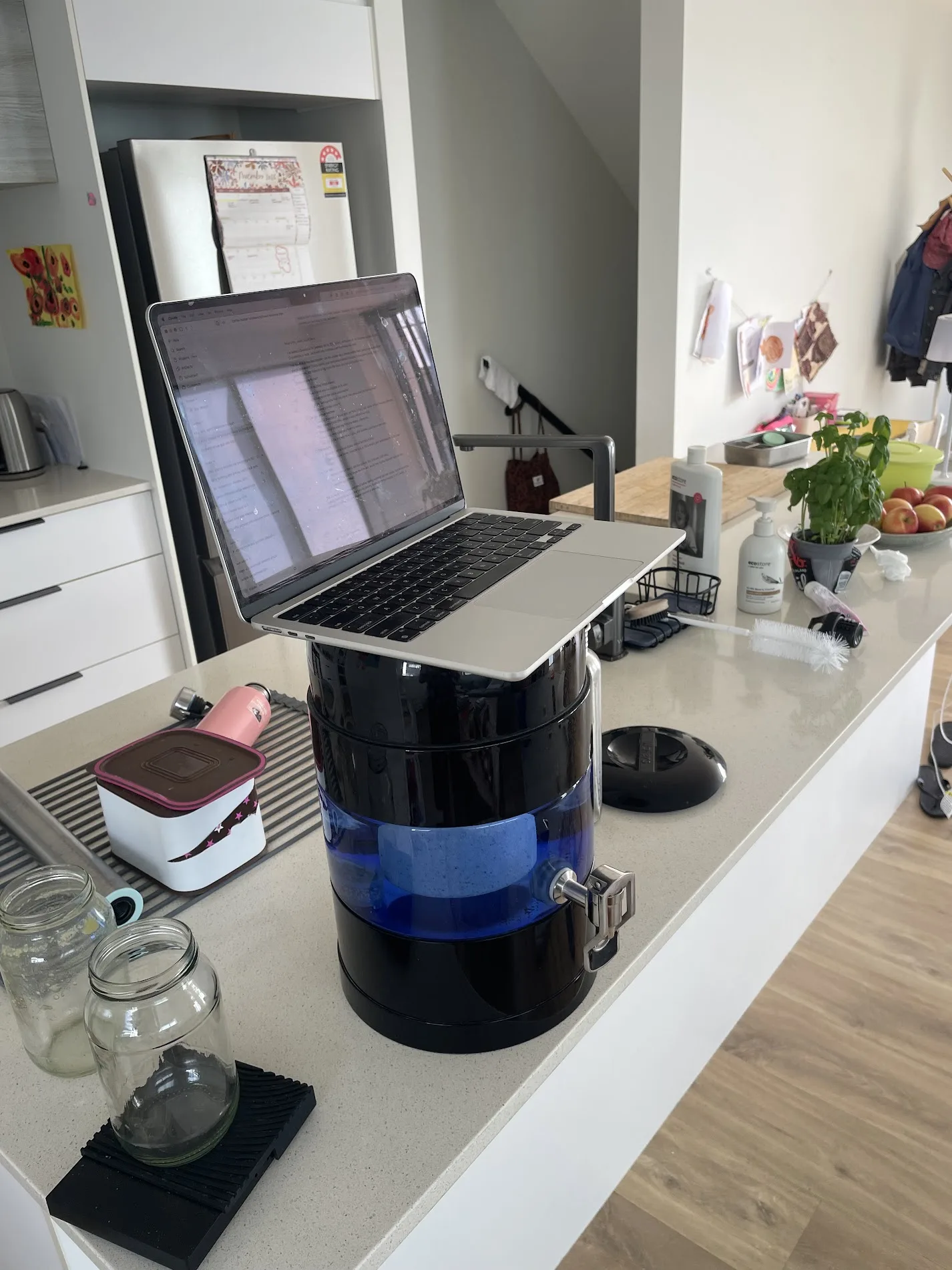
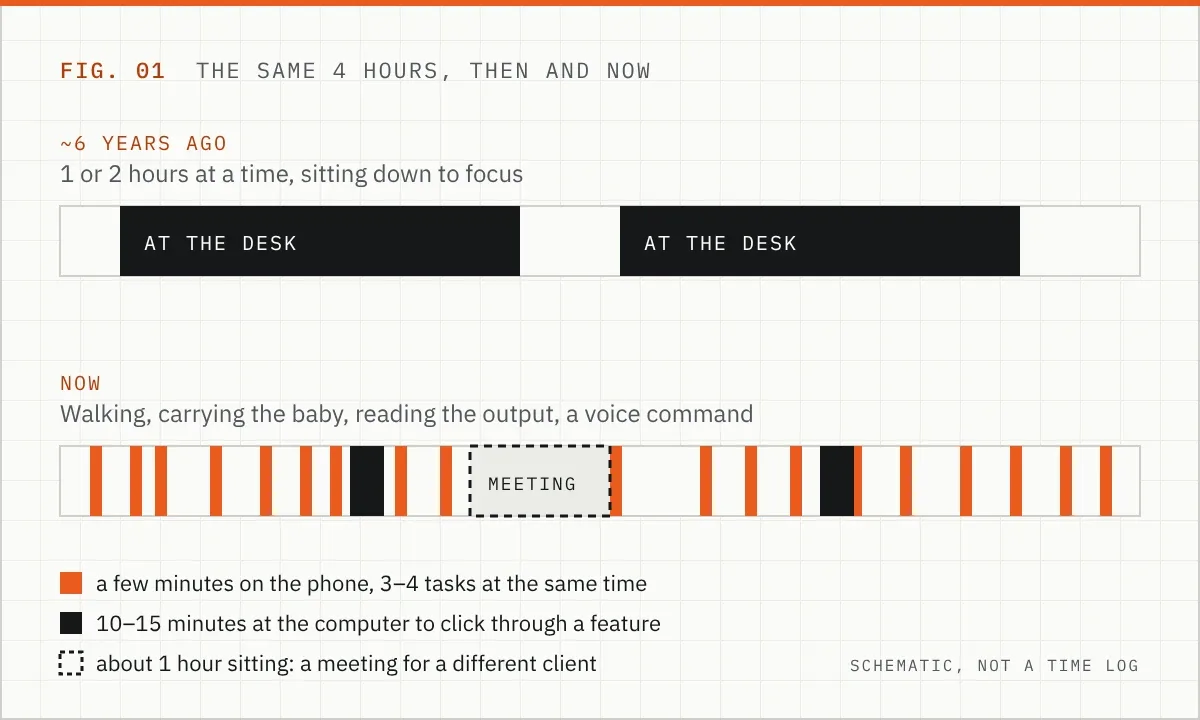
What that has enabled for me with agentic coding, and with the tooling that we have with Claude to control your Mac with voice to text, and to control sessions that are happening on your computer from your phone: yesterday I said to my wife that I spent about 1 hour sitting, and that was a meeting for a different client, and that was the only time I was sitting.
We've got three young kids, so of course I'm running around a lot, carrying them, taking care of them, all of that.
If this would have been the case maybe 6 years ago, I couldn't have done it like that. I would have probably needed these 4 hours as a close-to-each-other stretch, so I could focus, or at least 1 hour at a time or 2 hours at a time, that I could just really sit down and focus and solve a given problem.
Whereas now maybe you're walking around carrying your baby to sleep, and you're reading the output, and you're figuring out what it is, and you give a voice command, and everything runs back off, and you do that for four different tasks, and then you have some downtime.
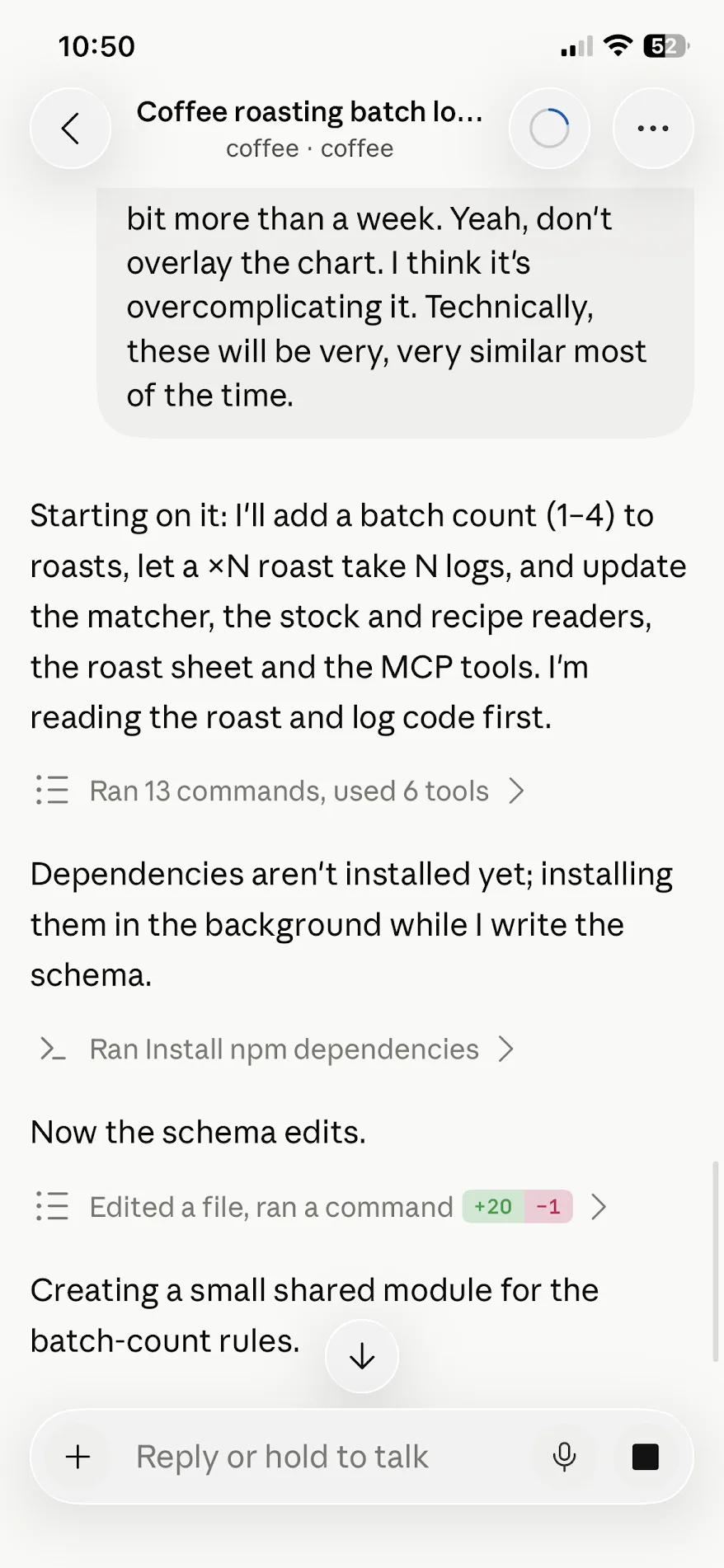
I'm now really not sitting down to work that often, but more running around and on my phone, voice to text, giving instructions and thinking about the higher level things, and then can step away for the deeper dives.
What does an agentic coding workflow look like when you run it from your phone?
Maybe this is actually beneficial for someone like myself. Not everybody is that way, but especially if I'm thinking about a topic or reading about a topic, I'm almost better when I'm walking because my brain is more active. I think that's something that's well studied, that the human brain is more active if you're walking or moving. This has certainly played into my cards, because I am so much better if I'm walking and moving.
So I get some sort of requirements that come from the business that might live somewhere in Jira, and I'll then take these and with a skill instruct an agent to scope up the issue. Then on the GitHub app, I might go and review the issue once it's scoped up and ready, give some comments, and once that's done, there's another agent that I'll kick off to go and implement this. The implementation goes through a skill with various bits and pieces and steps to make sure that it actually works and it produces proper coding. There's another review round.
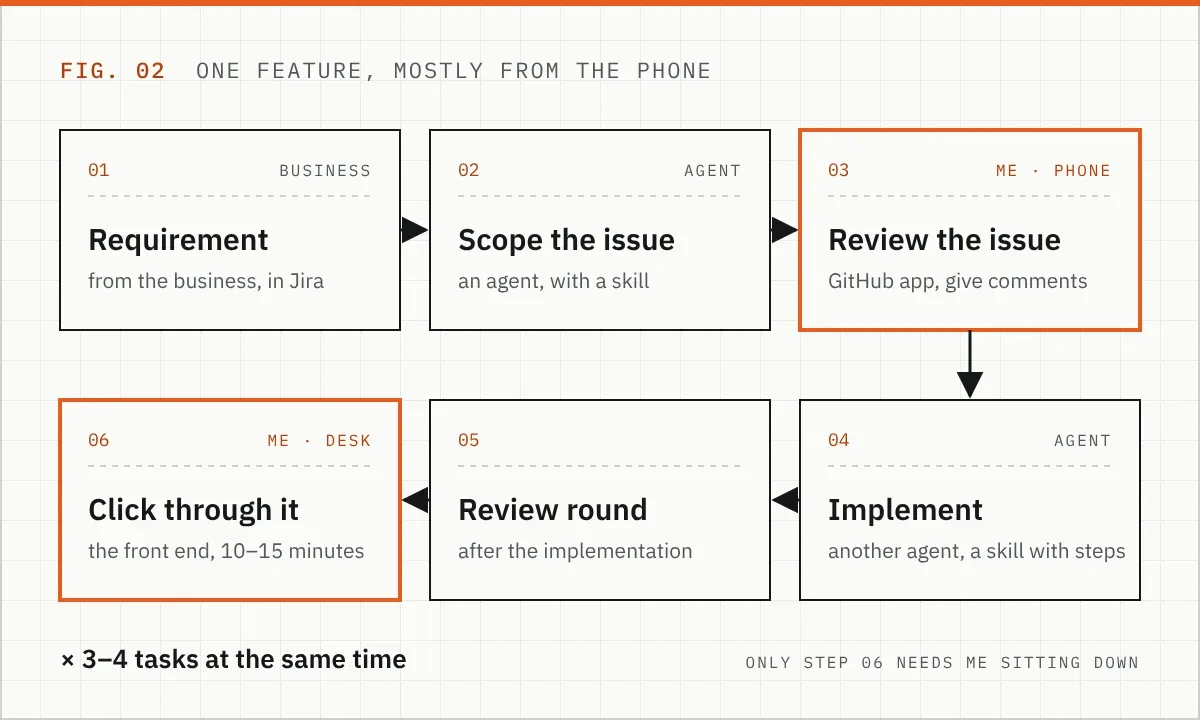
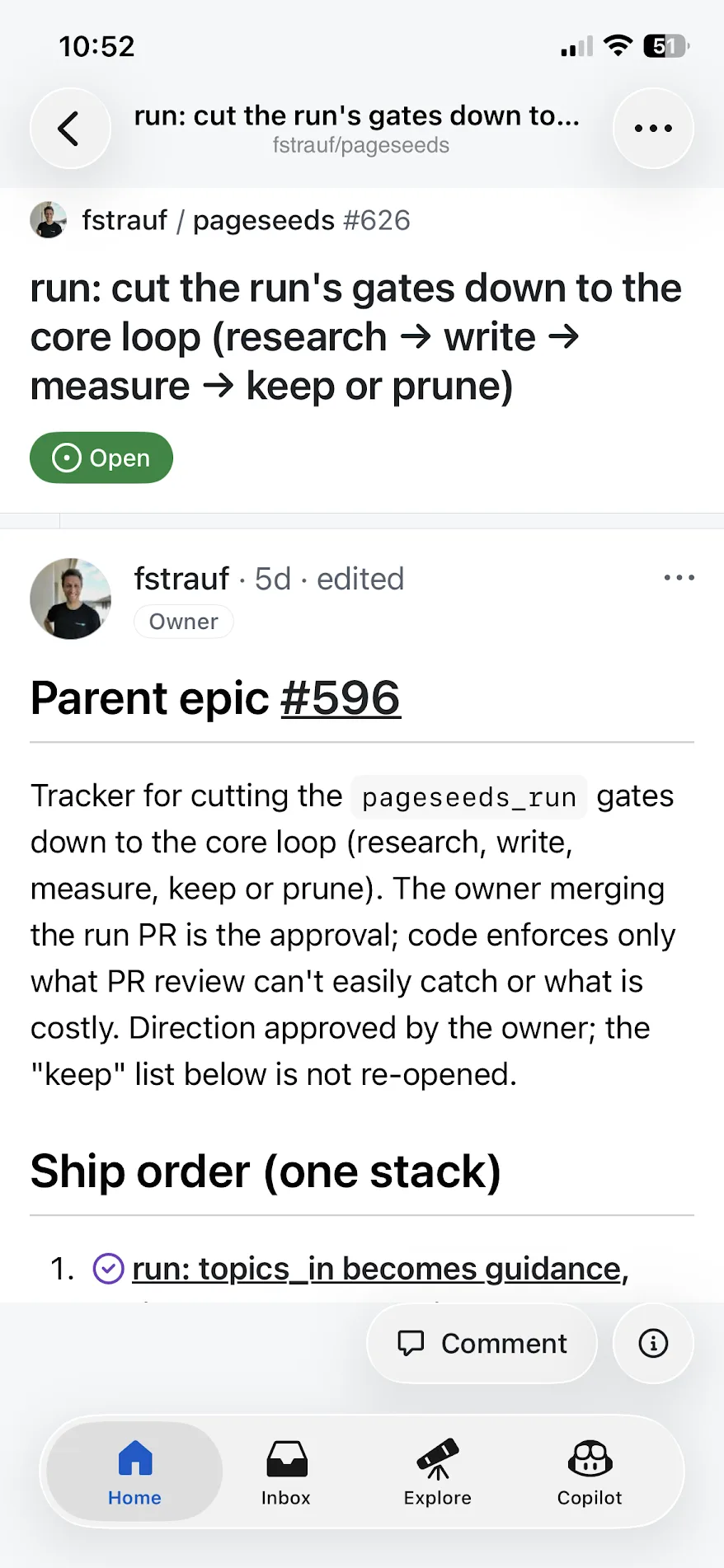
The only thing I still really need to go back to the computer for is the actual me testing out the feature. I'll try to automate as much as I can, but sometimes you just need to get into the front end and click through it. That's the only time where I need to sit down and do it. That might require me to do that for 10, 15 minutes.
That's okay. I can prepare as much as I can and then do the actual work. And since for the individual feature I've not really needed that much, I can do this routine for 3-4 tasks at the same time.
Doesn't working from your phone mean work leaks into family time?
Three young kids, and three or four tasks running in your head at the same time.
It's probably something for our current situation. For our current situation, it feels good because that's what we need right now. We need that additional manpower to help out, just because it is stressful with three kids.
But I think it is always the case. I guess that's just normal these days, that work also leaks into a lot of aspects of your life. And you need to deliberately focus on actually spending and taking that time, and also trying to shut off. It's not easy. You need to focus on it and do it so that you can spend time with the kids.
Often it is the case that a kid's task pulls me away. So I almost feel like I'm this short attention span TikTok person that can't watch an hour long video anymore or read a book anymore, because all I have is a 5 minute attention span in between that I can squeeze in to do the work.
Do you make more mistakes coding in five-minute windows?
You'll certainly make more mistakes. Maybe you have to have more rigorous process and steps going through everything to catch mistakes.
But I guess everybody's adapting to this agentic coding. I see my colleagues, they're getting 10, 15 pull requests a day with everything over 1,000 lines. That's something that wouldn't exist 5, 6 years ago, for just one person in a small organization. So I think everything is going through this shift.
Yes, if you can focus for an hour and sit down, you'll definitely be able to focus more and maybe get a review done better. But even on the phone, while walking, you can get yourself to think and focus on that better.
I'm not saying it is necessarily worse than before, because before maybe you were sitting on the computer, but you were distracted a lot, and that distraction also didn't make your code reviews great. So I think both of these could have ended up in the same direction.
If not 10x, what has agentic coding actually changed for you?
Before agentic coding got so good, I wouldn't have been able to work at all, or much less, or with higher costs for the family as a whole. But now that has changed, because I can still be around and can still do most of the things, and we can still survive and do 4 hours of work a day at least.
I'm seeing this more from a positive lens. This is something that could enable people to do different stuff. I'm already seeing that across my Twitter feed, that people are maybe traveling more, exploring more.
Pieter Levels comes to mind, of course, because he's been the most advocating for this, the whole vibe coding thing. You see him in an Uber driving somewhere, and at the same time shipping a new feature. And the attention span there also must be pretty divided.
So the ability to quickly refocus on a task and making decisions is something that seems to become more important as we move along this, with this getting better and better.
Can you keep working while travelling in a motorhome with kids?
We're also planning to travel in a couple of weeks, and I'm planning to continue to do work while we're traveling. Maybe I can keep up with the 4 hours a weekday and keep doing that with Starlink in the motorhome on the road.

Maybe while we're driving, maybe while the kids are in bed at night, maybe in the morning when they're still sleeping, maybe an hour in between when they're playing. I could just pull out the phone and the laptop and get some work done.
That's something that would not have been possible at all before. And that's amazing that this is now possible and I can do it.
Does agentic coding suit multitaskers more than deep-focus people?
Did you have to learn to refocus quickly, or did you always work that way?
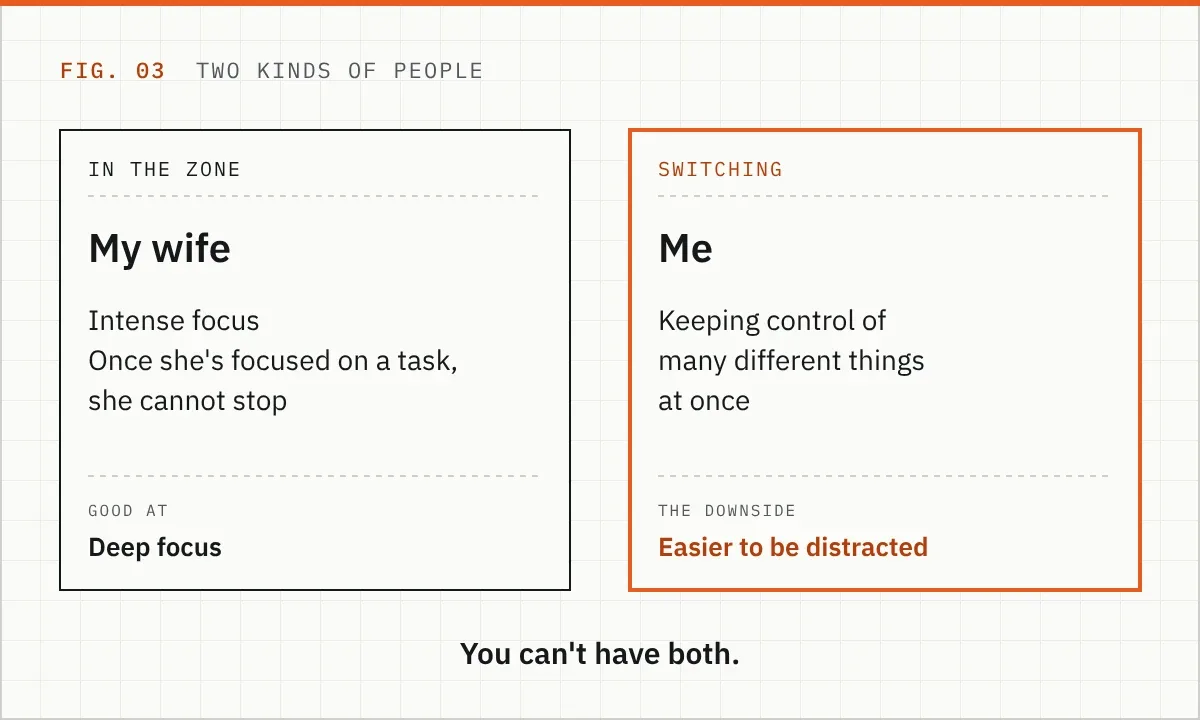
For me I've always had it. Guess I'm good at multitasking. I guess there's two kinds of people. There's the people that can have that intense focus and just be in the zone.
My wife has that. She's really good at that. Once she's focused on a task, she cannot stop. I'm on the other side.
I'm probably better at keeping control of that, be that a good or a bad thing. Often it's also a bad thing, but I think this plays into my hands a bit because I'm good at managing and doing many different things.
What's the downside of being good at multitasking?
You're easier to be distracted with that. Inherently, if you're good at doing multiple different things and switching focus, then you don't have that deep focus. That's the obvious downside. You can't have both.
Is flow state gone for software engineers?
When the kids are older and long sit-down blocks are possible again, would you go back?
I don't know. I think until then things will have changed so quickly. I already see engineers right now complaining about the loss of focus, or the loss of the ability to be in the flow.
I've talked about this, I think, before. You had a coding task, you'd be in the flow, in the zone, for a couple of hours, and you would just go about solving coding problems. That's something you think about all day long. And that seems to be gone in that sense.
Everybody seems to be forced down that multitasking path at the moment. I'm not sure where this is gonna go. Maybe it's gonna be more like high-level strategic thinking. And if it is that, everybody can have his own way of doing that.
Maybe people excel at doing that on the whiteboard. Maybe other people excel at doing that when sitting down in front of a computer writing it down. And maybe yet others excel at doing something like that while walking.
Get the next entry
New essays by email. No schedule, no spam. You confirm once.